 Gas/Liquid
Flowmeters Gas/Liquid
Flowmeters
|
|
Measuring
the flow of liquids is a critical need in many industrial
plants. In some operations, the ability to conduct accurate
flow measurements is so important that it can make the
difference between making a profit or taking a loss.
In other cases, inaccurate flow measurements or failure
to take measurements can cause serious (or even disastrous)
results.
With
most liquid flow measurement instruments, the flow rate
is determined inferentially by measuring the liquid's
velocity or the change in kinetic energy. Velocity depends
on the pressure differential that is forcing the liquid
through a pipe or conduit. Because the pipe's cross-sectional
area is known and remains constant, the average velocity
is an indication of the flow rate. The basic relationship
for determining the liquid's flow rate in such cases
is:
Q =
V x A
where
Q = liquid
flow through the pipe; V = average velocity of the flow;
A = cross-sectional area of the pipe.
Other
factors that affect liquid flow rate include the liquid's
viscosity and density, and the friction of the liquid
in contact with the pipe. Direct measurements of liquid
flows can be made with positive-displacement flowmeters.
These units divide the liquid into specific increments
and move it on. The total flow is an accumulation of
the measured increments, which can be counted by mechanical
or electronic techniques.
|
|
Reynolds
Numbers
The
performance of flowmeters is also influenced by a dimensionless
unit called the Reynolds Number. It is defined as the
ratio of the liquid's inertial forces to its drag forces.
The equation is:
R =
3160 x Q x Gt
D x
µ
where:
R = Reynolds number; Q = liquid's flow rate, gpm; Gt
= liquid's specific gravity; D = inside pipe diameter,
in.; µ = liquid's viscosity, cp.
|
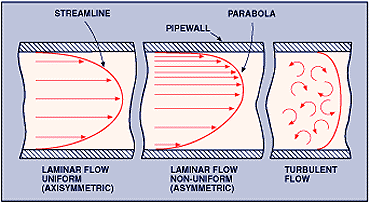
Figure
1: Laminar and turbulent flow are two types normally
encountered in liquid flow Measurement operations. Most
applications involve turbulent flow, with R values above
3000. Viscous liquids usually exhibit laminar flow,
with R values below 2000. The transition zone between
the two levels may be either laminar or turbulent.
|
|
The
flow rate and the specific gravity are inertia forces,
and the pipe diameter and viscosity are drag forces.
The pipe diameter and the specific gravity remain constant
for most liquid applications. At very low velocities
or high viscosities, R is low, and the liquid flows
in smooth layers with the highest velocity at the center
of the pipe and low velocities at the pipe wall where
the viscous forces restrain it. This type of flow is
called laminar flow. R values are below approximately
2000. A characteristic of laminar flow is the parabolic
shape of its velocity profile, Fig. 1.
However,
most applications involve turbulent flow, with R values
above 3000. Turbulent flow occurs at high velocities
or low viscosities. The flow breaks up into turbulent
eddies that flow through the pipe with the same average
velocity. Fluid velocity is less significant, and the
velocity profile is much more uniform in shape. A transition
zone exists between turbulent and laminar flows. Depending
on the piping configuration and other installation conditions,
the flow may be either turbulent or laminar in this
zone.
|
|
|
FLOWMETER
TYPES
Numerous
types of flowmeters are available for closed-piping
systems. In general, the equipment can be classified
as differential pressure, positive displacement, velocity,
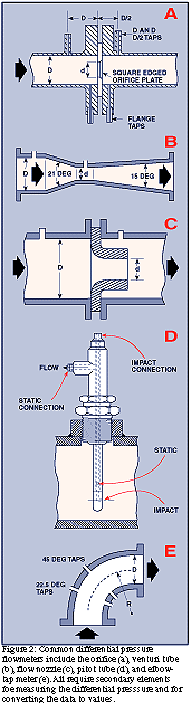
and mass meters. Differential pressure devices (also
known as head meters) include orifices, venturi tubes,
flow tubes, flow nozzles, pitot tubes, elbow-tap meters,
target meters, and variable-area meters, Fig. 2.
Positive
displacement meters include piston, oval-gear, nutating-disk,
and rotary-vane types. Velocity meters consist of turbine,
vortex shedding, electromagnetic, and sonic designs.
Mass meters include Coriolis and thermal types. The
measurement of liquid flows in open channels generally
involves weirs and flumes.
Space
limitations prevent a detailed discussion of all the
liquid flowmeters available today. However, summary
characteristics of common devices are shown in Table
1. (Click here to see Table1) Brief descriptions follow.
Differential
Pressure Meters
The
use of differential pressure as an inferred measurement
of a liquid's rate of flow is well known. Differential
pressure flowmeters are, by far, the most common units
in use today. Estimates are that over 50 percent of
all liquid flow measurement applications use this type
of unit.
The
basic operating principle of differential pressure flowmeters
is based on the premise that the pressure drop across
the meter is proportional to the square of the flow
rate. The flow rate is obtained by measuring the pressure
differential and extracting the square root.
Differential
pressure flowmeters, like most flowmeters, have a primary
and secondary element. The primary element causes a
change in kinetic energy, which creates the differential
pressure in the pipe. The unit must be properly matched
to the pipe size, flow conditions, and the liquid's
properties. And, the measurement accuracy of the element
must be good over a reasonable range. The secondary
element measures the differential pressure and provides
the signal or read-out that is converted to the actual
flow value.
Orifices
are the most popular liquid flowmeters in use today.
An orifice is simply a flat piece of metal with a specific-sized
hole bored in it. Most orifices are of the concentric
type, but eccentric, conical (quadrant), and segmental
designs are also available.
In
practice, the orifice plate is installed in the pipe
between two flanges. Acting as the primary device, the
orifice constricts the flow of liquid to produce a differential
pressure across the plate. Pressure taps on either side
of the plate are used to detect the difference. Major
advantages of orifices are that they have no moving
parts and their cost does not increase significantly
with pipe size.
Conical
and quadrant orifices are relatively new. The units
were developed primarily to measure liquids with low
Reynolds numbers. Essentially constant flow coefficients
can be maintained at R values below 5000. Conical orifice
plates have an upstream bevel, the depth and angle of
which must be calculated and machined for each application.
The
segmental wedge is a variation of the segmental orifice.
It is a restriction orifice primarily designed to measure
the flow of liquids containing solids. The unit has
the ability to measure flows at low Reynolds numbers
and still maintain the desired square-root relationship.
Its design is simple, and there is only one critical
dimension the wedge gap. Pressure drop through the unit
is only about half that of conventional orifices.
Integral
wedge assemblies combine the wedge element and pressure
taps into a one-piece pipe coupling bolted to a conventional
pressure transmitter. No special piping or fittings
are needed to install the device in a pipeline.
Metering
accuracy of all orifice flowmeters depends on the installation
conditions, the orifice area ratio, and the physical
properties of the liquid being measured.
Venturi
tubes have the advantage of being able to handle large
flow volumes at low pressure drops. A venturi tube is
essentially a section of pipe with a tapered entrance
and a straight throat. As liquid passes through the
throat, its velocity increases, causing a pressure differential
between the inlet and outlet regions.
The
flowmeters have no moving parts. They can be installed
in large diameter pipes using flanged, welded or threaded-end
fittings. Four or more pressure taps are usually installed
with the unit to average the measured pressure. Venturi
tubes can be used with most liquids, including those
having a high solids content.
Flow
tubes are somewhat similar to venturi tubes except that
they do not have the entrance cone. They have a tapered
throat, but the exit is elongated and smooth. The distance
between the front face and the tip is approximately
one-half the pipe diameter. Pressure taps are located
about one-half pipe diameter downstream and one pipe
diameter upstream.
Flow
Nozzles, at high velocities, can handle approximately
60 percent greater liquid flow than orifice plates having
the same pressure drop. Liquids with suspended solids
can also be metered. However, use of the units is not
recommended for highly viscous liquids or those containing
large amounts of sticky solids.
Pitot
tubes sense two pressures simultaneously, impact and
static. The impact unit consists of a tube with one
end bent at right angles toward the flow direction.
The static tube's end is closed, but a small slot is
located in the side of the unit. The tubes can be mounted
separately in a pipe or combined in a single casing.
Pitot
tubes are generally installed by welding a coupling
on a pipe and inserting the probe through the coupling.
Use of most pitot tubes is limited to single point measurements.
The units are susceptible to plugging by foreign material
in the liquid. Advantages of pitot tubes are low cost,
absence of moving parts, easy installation, and minimum
pressure drop.
Elbow
meters operate on the principle that when liquid travels
in a circular path, centrifugal force is exerted along
the outer edges. Thus, when liquid flows through a pipe
elbow, the force on the elbow's interior surface is
proportional to the density of the liquid times the
square of its velocity. In addition, the force is inversely
proportional to the elbow's radius.
Any
90 deg. pipe elbow can serve as a liquid flowmeter.
All that is required is the placement of two small holes
in the elbow's midpoint (45 deg. point) for piezometer
taps. Pressure-sensing lines can be attached to the
taps by using any convenient method.
Target
meters sense and measure forces caused by liquid impacting
on a target or drag-disk suspended in the liquid stream.
A direct indication of the liquid flow rate is achieved
by measuring the force exerted on the target. In its
simplest form, the meter consists only of a hinged,
swinging plate that moves outward, along with the liquid
stream. In such cases, the device serves as a flow indicator.
A
more sophisticated version uses a precision, low-level
force transducer sensing element. The force of the target
caused by the liquid flow is sensed by a strain gage.
The output signal from the gage is indicative of the
flow rate. Target meters are useful for measuring flows
of dirty or corrosive liquids.
|
|
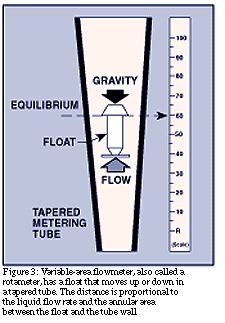
Variable-area
meters, often called rotameters, consist essentially
of a tapered tube and a float, Fig. 3. Although classified
as differential pressure units, they are, in reality,
constant differential pressure devices. Flanged-end
fittings provide an easy means for installing them in
pipes. When there is no liquid flow, the float rests
freely at the bottom of the tube. As liquid enters the
bottom of the tube, the float begins to rise. The position
of the float varies directly with the flow rate. Its
exact position is at the point where the differential
pressure between the upper and lower surfaces balance
the weight of the float.
Because
the flow rate can be read directly on a scale mounted
next to the tube, no secondary flow-reading devices
are necessary. However, if desired, automatic sensing
devices can be used to sense the float's level and transmit
a flow signal. Rotameter tubes are manufactured from
glass, metal, or plastic. Tube diameters vary from 1/4
to greater than 6 in.
|
|
|
Positive-Displacement
Meters
Operation
of these units consists of separating liquids into accurately
measured increments and moving them on. Each segment
is counted by a connecting register. Because every increment
represents a discrete volume, positive-displacement
units are popular for automatic batching and accounting
applications. Positive-displacement meters are good
candidates for measuring the flows of viscous liquids
or for use where a simple mechanical meter system is
needed.
|
|
|
|
Reciprocating
piston meters are of the single and multiple-piston
types. The specific choice depends on the range of flow
rates required in the particular application. Piston
meters can be used to handle a wide variety of liquids.
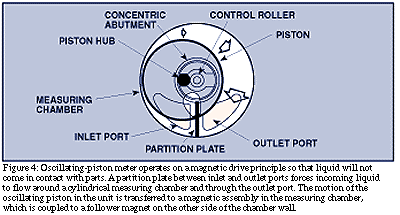
A magnetically driven, oscillating piston meter is shown
in Fig. 4. Liquid never comes in contact with gears
or other parts that might clog or corrode.
Oval-gear
meters have two rotating, oval-shaped gears with synchronized,
close fitting teeth. A fixed quantity of liquid passes
through the meter for each revolution. Shaft rotation
can be monitored to obtain specific flow rates.
Nutating-disk
meters have a moveable disk mounted on a concentric
sphere located in a spherical side-walled chamber. The
pressure of the liquid passing through the measuring
chamber causes the disk to rock in a circulating path
without rotating about its own axis. It is the only
moving part in the measuring chamber.
A
pin extending perpendicularly from the disk is connected
to a mechanical counter that monitors the disk's rocking
motions. Each cycle is proportional to a specific quantity
of flow. As is true with all positive-displacement meters,
viscosity variations below a given threshold will affect
measuring accuracies. Many sizes and capacities are
available. The units can be made from a wide selection
of construction materials.
Rotary-vane
meters are available in several designs, but they all
operate on the same principle. The basic unit consists
of an equally divided, rotating impeller (containing
two or more compartments) mounted inside the meter's
housing. The impeller is in continuous contact with
the casing. A fixed volume of liquid is swept to the
meter's outlet from each compartment as the impeller
rotates. The revolutions of the impeller are counted
and registered in volumetric units.
Helix
flowmeters consist of two radically pitched helical
rotors geared together, with a small clearance between
the rotors and the casing. The two rotors displace liquid
axially from one end of the chamber to the other.
|
|
Velocity
Meters
These
instruments operate linearly with respect to the volume
flow rate. Because there is no square-root relationship
(as with differential pressure devices), their rangeability
is greater. Velocity meters have minimum sensitivity
to viscosity changes when used at Reynolds numbers above
10,000. Most velocity-type meter housings are equipped
with flanges or fittings to permit them to be connected
directly into pipelines.
|
|
|
|
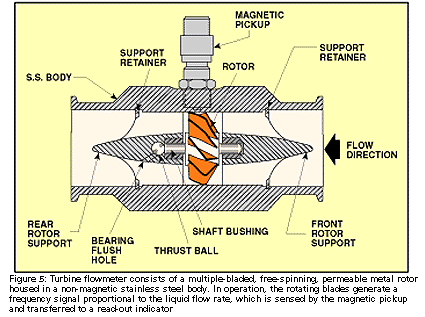
Turbine
meters have found widespread use for accurate liquid
measurement applications. The unit consists of a multiple-bladed
rotor mounted with a pipe, perpendicular to the liquid
flow. The rotor spins as the liquid passes through the
blades. The rotational speed is a direct function of
flow rate and can be sensed by magnetic pick-up, photoelectric
cell, or gears. Electrical pulses can be counted and
totalized, Fig. 5.
The
number of electrical pulses counted for a given period
of time is directly proportional to flow volume. A tachometer
can be added to measure the turbine's rotational speed
and to determine the liquid flow rate. Turbine meters,
when properly specified and installed, have good accuracy,
particularly with low-viscosity liquids.
A
major concern with turbine meters is bearing wear. A
"bearingless" design has been developed to
avoid this problem. Liquid entering the meter travels
through the spiraling vanes of a stator that imparts
rotation to the liquid stream. The stream acts on a
sphere, causing it to orbit in the space between the
first stator and a similarly spiraled second stator.
The orbiting movement of the sphere is detected electronically.
The frequency of the resulting pulse output is proportional
to flow rate.
|
|
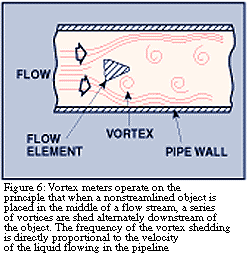
Vortex
meters make use of a natural phenomenon that occurs
when a liquid flows around a bluff object. Eddies or
vortices are shed alternately downstream of the object.
The frequency of the vortex shedding is directly proportional
to the velocity of the liquid flowing through the meter,
Fig. 6.
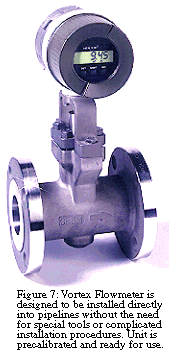
The
three major components of the flowmeter are a bluff
body strut-mounted across the flowmeter bore, a sensor
to detect the presence of the vortex and to generate
an electrical impulse, and a signal amplification and
conditioning transmitter whose output is proportional
to the flow rate, Fig. 7. The meter is equally suitable
for flow rate or flow totalization measurements. Use
for slurries or high viscosity liquids is not recommended.
|
|
|
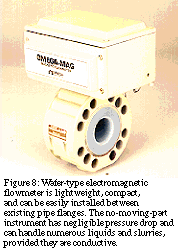
Electromagnetic
meters can handle most liquids and slurries, providing
that the material being metered is electrically conductive.
Major components are the flow tube (primary element),
Fig. 8. The flow tube mounts directly in the pipe. Pressure
drop across the meter is the same as it is through an
equivalent length of pipe because there are no moving
parts or obstructions to the flow. The voltmeter can
be attached directly to the flow tube or can be mounted
remotely and connected to it by a shielded cable.
Electromagnetic
flowmeters operate on Faraday's law of electromagnetic
induction that states that a voltage will be induced
when a conductor moves through a magnetic field. The
liquid serves as the conductor; the magnetic field is
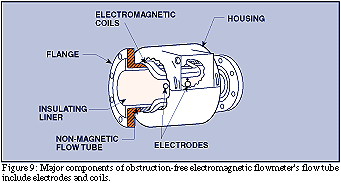
created by energized coils outside the flow tube, Fig.
9. The amount of voltage produced is directly proportional
to the flow rate. Two electrodes mounted in the pipe
wall detect the voltage, which is measured by the secondary
element.
Electromagnetic
flowmeters have major advantages: They can measure difficult
and corrosive liquids and slurries; and they can measure
forward as well as reverse flow with equal accuracy.
Disadvantages of earlier designs were high power consumption,
and the need to obtain a full pipe and no flow to initially
set the meter to zero. Recent improvements have eliminated
these problems. Pulse-type excitation techniques have
reduced power consumption, because excitation occurs
only half the time in the unit. Zero settings are no
longer required.
|
|
|
Ultrasonic
flowmeters can be divided into Doppler meters and time-of-travel
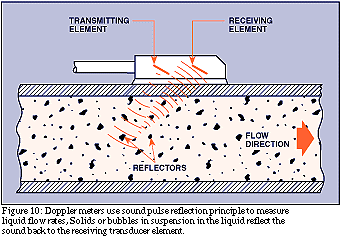
(or transit) meters. Doppler meters measure the frequency
shifts caused by liquid flow. Two transducers are mounted
in a case attached to one side of the pipe. A signal
of known frequency is sent into the liquid to be measured.
Solids, bubbles, or any discontinuity in the liquid,
cause the pulse to be reflected to the receiver element,
Fig. 10. Because the liquid causing the reflection is
moving, the frequency of the returned pulse is shifted.
The frequency shift is proportional to the liquid's
velocity.
|
|
|
A
portable Doppler meter capable of being operated on
AC power or from a rechargeable power pack has recently
been developed. The sensing heads are simply clamped
to the outside of the pipe, and the instrument is ready
to be used. Total weight, including the case, is 22
lb. A set of 4 to 20 millampere output terminals permits
the unit to be connected to a strip chart recorder or
other remote device.
Time-of-travel
meters have transducers mounted on each side of the
pipe. The configuration is such that the sound waves
traveling between the devices are at a 45 deg. angle
to the direction of liquid flow. The speed of the signal
traveling between the transducers increases or decreases
with the direction of transmission and the velocity
of the liquid being measured. A time-differential relationship
proportional to the flow can be obtained by transmitting
the signal alternately in both directions. A limitation
of time-of-travel meters is that the liquids being measured
must be relatively free of entrained gas or solids to
minimize signal scattering and absorption.
|
|
|
|
Mass Flowmeters
The continuing need for more accurate flow measurements
in mass-related processes (chemical reactions, heat
transfer, etc.) has resulted in the development of mass
flowmeters. Various designs are available, but the one
most commonly used for liquid flow applications is the
Coriolis meter. Its operation is based on the natural
phenomenon called the Coriolis force, hence the name.
|
|
|
|
Coriolis
meters are true mass meters that measure the mass rate
of flow directly as opposed to volumetric flow. Because
mass does not change, the meter is linear without having
to be adjusted for variations in liquid properties.
It also eliminates the need to compensate for changing
temperature and pressure conditions. The meter is especially
useful for measuring liquids whose viscosity varies
with velocity at given temperatures and pressures.
Coriolis
meters are also available in various designs. A popular
unit consists of a U-shaped flow tube enclosed in a
sensor housing connected to an electronics unit. The
sensing unit can be installed directly into any process.
The electronics unit can be located up to 500 feet from
the sensor.
Inside
the sensor housing, the U-shaped flow tube is vibrated
at its natural frequency by a magnetic device located
at the bend of the tube. The vibration is similar to
that of a tuning fork, covering less than 0.1 in. and
completing a full cycle about 80 times/sec. As the liquid
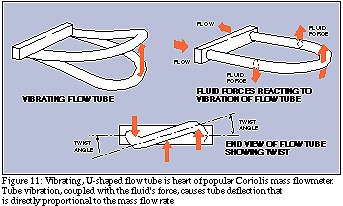
flows through the tube, it is forced to take on the
vertical movement of the tube, Fig. 11. When the tube
is moving upward during half of its cycle, the liquid
flowing into the meter resists being forced up by pushing
down on the tube.
|
|
|
|
Having
been forced upward, the liquid flowing out of the meter
resists having its vertical motion decreased by pushing
up on the tube. This action causes the tube to twist.
When the tube is moving downward during the second half
of its vibration cycle, it twists in the opposite direction.
Having
been forced upward, the liquid flowing out of the meter
resists having its vertical motion decreased by pushing
up on the tube. This action causes the tube to twist.
When the tube is moving downward during the second half
of its vibration cycle, it twists in the opposite direction.
The ammount of twist is directly proportional to the
mass flow rate of the liquid flowing through the tube.
Magnetic sensors located on each side of the flow tube
measure the tube velocities, which change as the tube
twists. The sensors feed this information to the electronics
unit, where it is processed and converted to a voltage
proportional to mass flow rate. The meter has a wide
range of applications from adhesives and coatings to
liquid nitrogen.
Thermal-type
mass flowmeters have traditionally been used for gas
measurements, but designs for liquid flow measurements
are available. These mass meters also operate independent
of density, pressure, and viscosity. Thermal meters
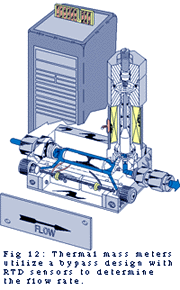
use a heated sensing element isolated from the fluid
flow path. The flow stream conducts heat from the sensing
element. The conducted heat is directly proportional
to the mass flow rate. The sensor never comes into direct
contact with the liquid, Fig. 12. The electronics package
includes the flow analyzer, temperature compensator,
and a signal conditioner that provides a linear output
directly proportional to mass flow.
|
|
Open
Channel Meters
The "open
channel" refers to any conduit in which liquid
flows with a free surface. Included are tunnels, nonpressurized
sewers, partially filled pipes, canals, streams, and
rivers. Of the many techniques available for monitoring
open-channel flows, depth-related methods are the most
common. These techniques presume that the instantaneous
flow rate may be determined from a measurement of the
water depth, or head. Weirs and flumes are the oldest
and most widely used primary devices for measuring open-channel
flows.
|
|
|
Weirs
operate on the principle that an obstruction in a channel
will cause water to back up, creating a high level (head)
behind the barrier. The head is a function of flow velocity,
and, therefore, the flow rate through the device. Weirs
consist of vertical plates with sharp crests. The top
of the plate can be straight or notched. Weirs are classified
in accordance with the shape of the notch. The basic
types are V-notch, rectangular, and trapezoidal.
Flumes
are generally used when head loss must be kept to a
minimum, or if the flowing liquid contains large amounts
of suspended solids. Flumes are to open channels what
venturi tubes are to closed pipes. Popular flumes are
the Parshall and Palmer-Bowlus designs.
The
Parshall flume consists of a converging upstream section,
a throat, and a diverging downstream section. Flume
walls are vertical and the floor of the throat is inclined
downward. Head loss through Parshall flumes is lower
than for other types of open-channel flow measuring
devices. High flow velocities help make the flume self-cleaning.
Flow can be measured accurately under a wide range of
conditions.
Palmer-Bowlus
flumes have a trapezoidal throat of uniform cross section
and a length about equal to the diameter of the pipe
in which it is installed. It is comparable to a Parshall
flume in accuracy and in ability to pass debris without
cleaning. A principal advantage is the comparative ease
with which it can be installed in existing circular
conduits, because a rectangular approach section is
not required.
Discharge
through weirs and flumes is a function of level, so
level measurement techniques must be used with the equipment
to determine flow rates. Staff gages and float-operated
units are the simplest devices used for this purpose.
Various electronic sensing, totalizing, and recording
systems are also available.
A
more recent development consists of using ultrasonic
pulses to measure liquid levels. Measurements are made
by sending sound pulses from a sensor to the surface
of the liquid, and timing the echo return. Linearizing
circuitry converts the height of the liquid into flow
rate. A strip chart recorder logs the flow rate, and
a digital totalizer registers the total gallons. Another
recently introduced microprocessor-based system uses
either ultrasonic or float sensors. A key-pad with an
interactive liquid crystal display simplifies programming,
control, and calibration tasks.
SELECTING
A FLOWMETER
Experts
claim that over 75 percent of the flowmeters installed
in industry are not performing satisfactorily. And improper
selection accounts for 90 percent of these problems.
Obviously, flowmeter selection is no job for amateurs.
The
most important requirement is knowing exactly what the
instrument is supposed to do. Here are some questions
to consider. Is the measurement for process control
(where repeatability is the major concern), or for accounting
or custody transfer (where high accuracy is important)?
Is local indication or a remote signal required? If
a remote output is required, is it to be a proportional
signal, or a contact closure to start or stop another
device? Is the liquid viscous, clean, or a slurry? Is
it electrically conductive? What is its specific gravity
or density? What flow rates are involved in the application?
What are the processes' operating temperatures and pressures?
Accuracy (see glossary), range, linearity, repeatability,
and piping requirements must also be considered.
It
is just as important to know what a flowmeter cannot
do as well as what it can do before a final selection
is made. Each instrument has advantages and disadvantages,
and the degree of performance satisfaction is directly
related to how well an instrument's capabilities and
shortcomings are matched to the application's requirements.
Often, users have expectations of a flowmeter's performance
that are not consistent with what the supplier has provided.
Most suppliers are anxious to help customers pick the
right flowmeter for a particular job. Many provide questionnaires,
checklists, and specification sheets designed to obtain
the critical information necessary to match the correct
flowmeter to the job.
Technological
improvements of flowmeters must be considered also.
For example, a common mistake is to select a design
that was most popular for a given application some years
ago and to assume that it is still the best instrument
for the job. Many changes and innovations may have occurred
in recent years in the development of flowmeters for
that particular application, making the choice much
broader.
Calibration
All
flowmeters require an initial calibration. Most of the
time, the instrument is calibrated by the manufacturer
for the specified service conditions. However, if qualified
personnel are available in the plant, the user can perform
his own calibrations.
The
need to recalibrate depends to a great extent on how
well the meter fits the application. Some liquids passing
through flowmeters tend to be abrasive, erosive, or
corrosive. In time, portions of the device will deteriorate
sufficiently to affect performance. Some designs are
more susceptible to damage than others. For example,
wear of individual turbine blades will cause performance
changes. If the application is critical, flowmeter accuracy
should be checked at frequent intervals. In other cases,
recalibration may not be necessary for years because
the application is noncritical, or nothing will change
the meter's performance. Some flowmeters require special
equipment for calibration. Most manufacturers will provide
such service in their plant or in the user's facility,
where they will bring the equipment for on-site calibration.
Maintenance
A
number of factors influence maintenance requirements
and the life expectancy of flowmeters. The major factor,
of course, is matching the right instrument to the particular
application. Poorly selected devices invariably will
cause problems at an early date. Flowmeters with no
moving parts usually will require less attention than
units with moving parts. But all flowmeters eventually
require some kind of maintenance.
Primary
elements in differential pressure flowmeters require
extensive piping, valves, and fittings when they are
connected to their secondary elements, so maintenance
may be a recurring effort in such installations. Impulse
lines can plug or corrode and have to be cleaned or
replaced. And, improper location of the secondary element
can result in measurement errors. Relocating the element
can be expensive.
Flowmeters
with moving parts require periodic internal inspection,
especially if the liquid being metered is dirty or viscous.
Installing filters ahead of such units will help minimize
fouling and wear. Obstructionless instruments, such
as ultrasonic or electromagnetic meters, may develop
problems with their secondary element's electronic components.
Pressure sensors associated with secondary elements
should be periodically removed and inspected.
Applications
where coatings may occur are also potential problems
for obstructionless instruments such as magnetic or
ultrasonic units. If the coating is insulating, the
operation of magnetic flowmeters will ultimately be
impaired if the electrodes are insulated from the liquid.
This condition will be prevented by periodic cleaning.
With ultrasonic flowmeters, refraction angles may change
and the sonic energy absorbed by the coating will cause
the meter to become inoperative.
|
 go to product
order go to product
order
For any particular request please
contact:
info@flokal.eu
|


