|
Introduction
Platinum
is a metallic, silvery-white element. It is a chemical
element of the 10th group of the periodic system
with an atomic number of 78. The 37 isotopes are
known from 166Pt until 202Pt.
The five of these isotopes are stable: 192Pt,
194Pt, 195Pt, 196Pt,
198Pt and one radioisotope 190Pt
(T1/2=6.5•10+11
years). The major source of Platinum is the platinum
arsenide (PtAs2), sperrylit associated
with nickel ores. Also the rare sulfide mineral
cooperite, (Pt,Pd,Ni)S, contains platinum along
with palladium and nickel. The unique physical
properties of Platinum and related alloys have found
many applications in modern industry.
Physical
Properties of Platinum
|
Atomic
weight
|
195.08
amu
|
|
Atomic
radius (Goldschmid)
|
0.138pm
|
|
Electronic
structure
|
[Xe]
4f145d96S1
|
|
Crystal
structure
|
Face
centred cubic
|
|
Oxidation
number
|
1,
2,
3, 4
|
|
Electronegativities
|
2.28
|
|
Density
(20 °C)
|
21.45
g•cm-3
|
|
Melting
point
|
1772
°C
|
|
Boiling
point
|
3827
°C
|
|
Electrical
resistivity (20 °C)
|
10.58
μΩ•cm
|
|
Temperature
coefficient (0-100 °C)
|
0.00392
K-1
|
|
Coefficient
of termal expansion (0°C - 100°C)
|
9.0•10-6K-1
|
|
Latent
heat of evaporation
|
2405
J•g-1
|
|
Latent
heat of fusion
|
133
J•g-1
|
|
Thermal
conductivity (0-100 °C)
|
71.6
Wm-1K-1
|
|
|
Few
of us are aware of the range of uses for platinum
group metals (PGMs). Today's catalytic converters
and tomorrow's fuel cells are just two of the
many applications that offer great promises
to benefit our environment. Yet PGMs are also
used in applications that contribute to our
health and well-being, acting as key components
in certain anti-cancer drugs, and a range of
surgical implants and prosthetics.They are also
crucial in industrial processes such as fiberglass
production and gasoline refining. Many new technologies
from mobile telephones to the computer screen
on which you're reading this page all owe their
operation to PGMs. Even the car you drive may
have half a dozen or so functions that rely
on one or more of these metals. So when you
include their everyday uses in items such as
fountain pens, razors and jewellery, you can
see that the PGMs are all around us and will
increasingly be so in the years to come.
|
|
|
Environmental |
|
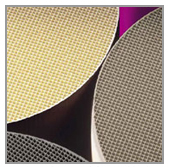
 Catalytic
Converters Catalytic
Converters
For
years, catalytic converters have been used for
their pollution abatement potential. They were
first introduced in the USA and since 1981 all
cars and light duty trucks sold in the US must
include catalytic converters as standard equipment.
Not just the US, 85% of cars sold worldwide
are now fitted with three way catalytic converters.
In fact, the average family car in the US would
emit 15 tons of toxic and harmful polluting
gases (carbon monoxide, hydrocarbons and nitrogen
oxides), over a 10-year life, if catalytic converters
were not fitted to all new cars to remove up
to 98% of pollution as required by current regulations.
Catalytic converters are also an efficient means
of reducing pollution from diesel engines. Catalytic
converters for diesel vehicles have shown to
demonstrably lower not only particulate matter
but also carbon monoxide and NOx emissions.
|
|
|
Fuel
Cells
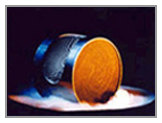
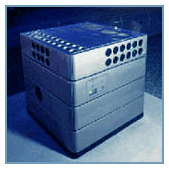
Fuel
cells are a rapidly developing energy conversion
technology. Offering higher efficiencies than
conventional technologies, they also operate
quietly. Their modular construction means they
can be economically and easily scaled down to
small sizes to fit many applications. These
features make fuel cells attractive for a range
of potential applications, from combined heat
and power (CHP) to distributed power generation
to transport and portable power for mobile appliances.
|
|
|
Electronic
Components
Being
good conductors, ductile when annealed and oxidation
resistant with high temperature stability, platinum,
palladium and ruthenium provide an alternative
and more effective plating to gold on connectors
and circuit boards. The improved durability
and reliability which these metals provide reduces
the need for replacement and disposal.
|
|
|
Medical
|
|
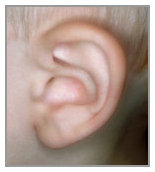
Aural
Implants : helping the deaf to hear again
Aural
implants to replace damaged or malfunctioning
cochlears in those suffering from deafness,
by electrically stimulating the auditory nerve,
contain platinum and iridium whose electrical
conductivity, durability, biological compatibility
and oxidation resistance make them perfect for
the electrodes in the implants.
|
|
|
Cancer
: effective measures to counter a deadly disease
PGMs'
role in the fight against cancer is twofold:
as the active ingredient in chemotherapy drugs
and in radio-active implants for radiation therapy
(brachytherapy). In the first of these, platinum
compounds cisplatinum and carboplatinum have
the unique quality of inhibiting the splitting
and growth of cancerous cells. These compounds
have been particularly successful in the treatment
of testicular and ovarian cancers. More recently,
palladium compounds have also been successfully
tested. In brachytherapy, implants are made
of platinum with the active ingredient of iridium
isotopes. These are placed directly into tumours,
giving a high radiation dose to the tumour while
reducing the effect on surrounding healthy tissue.
|
|
Parkinson's
Disease : relief for sufferers
It
is estimated that four million people worldwide
have Parkinson's disease, a neurological condition
with a range of symptoms including essential
tremor (shaking) and rigidity. The latest advances
in combating this condition are neural implants
made of platinum and iridium that generate an
electrical impulse which stimulates a targeted
area of the brain and reduces the shaking and
rigidity almost immediately.
|
|
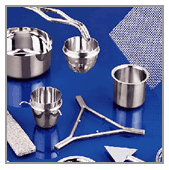
Micro-precision
surgical Tools: safe and effective surgery.
Ever
more complicated and vital surgical procedures
require reliable, safe and effective tools to
ensure success. The platinum-iridium alloy combines
these two metals' strength, durability and biological
compatibility to produce surgical tools of exceptional
quality and effectiveness.
|
|
|
Pacemakers
and Implantable Defibrillators: saving the lives
of those with heart conditions.
Pacemakers
and implantable defibrillators deliver electric
shocks of varying strength to the hearts of
those suffering from cardiac disorders, helping
to effectively regulate the beating of the heart.
Durable, conductive and biologically compatible,
platinum is perfect for the electrodes and electrical
contacts which are crucial to these implants'
functioning.
|

|
|
Retinal
Implants: advancing the possibilities for restoring
sight.
A
good example of how future technologies are
becoming reality today is the advances in retinal
implants to improve damaged or deteriorating
eyesight. The electrodes and wires in such implants
are made of platinum and iridium whose electrical
conductivity, durability, biological compatibility
and oxidation resistance make them perfect for
such a role.
|

|
|
Industrial |
|
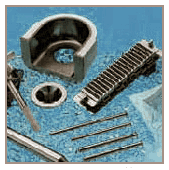
Alloys:
improving the hardness and durability of metals.
Because
of their own hardness and density, rhodium,
iridium, ruthenium and osmium alloy with platinum
and palladium to produce metals which combine
the best qualities of each with a unique hardness
and durability. PGMs can have a quite remarkable
effect on other metals. For example, titanium's
corrosion resistance is boosted a hundred times
by the addition of just 0.1% of ruthenium. This
gives titanium an even more effective and durable
role in aerospace and marine applications where
resistance to extremes of temperature and salt
water is crucial. Application for alloys between
the PGMs include fuel cells, industrial crucibles
and tools, and jewellery.
|
|
|
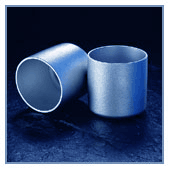
Industrial
Crucibles: producing everyday goods, reducing
the impact on the environment.
Because
of their hardness, high melting points and high
temperature stability PGMs are the perfect coating
for industrial crucibles where high temperatures
are necessary to produce chemicals and synthetics
with the utmost efficiency. The high temperature
stability, melting points and corrosion resistance
of platinum, rhodium, iridium, ruthenium and
their alloys allow for higher temperatures to
be achieved in crucibles, a key factor in any
chemical process. The "nobility" of
PGMs is also crucial. High purity conditions
are required for these processes and PGMs' high
temperature stability means that they do not
contaminate the products being fabricated. Products
produced in such ways include: artificial silk;
crystals; glass; glass fibre.
|

|
|
Glass:
optical quality for a range of applications.
Optically
pure, flat glass improves the quality of televisions,
monitors and Liquid Crystal Displays. It is
produced in crucibles made of PGMs and their
alloys where extremely high temperatures give
maximum efficiency to the reaction necessary
to synthesise such glass.
|
|
|
Glass
Fibre.
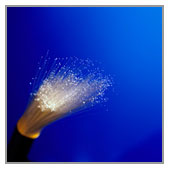
Glass
fibre's versatility finds its use in a range
of applications. These are just a few of its
uses: as a reinforcer for plastic and concrete;
in insulation for buildings; in the hulls of
ships, fuselages of aircraft and walls of petrol
tankers, and in everyday products such as ladders
and fishing rods. Glass fibre optics are used
in telecommunications applications where they
have greater capacity, transmission speed and
efficiency and are cheaper to maintain than
other cables. It is produced in crucibles made
of PGMs and their alloys which are resistant
to the high temperature and corrociveness of
molten glass.
|
|
|
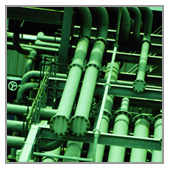
Petroleum
Refining: high performance fuels for the modern
automobile.
Low
octane petroleum is converted into high octane
with platinum-based reforming catalysts, heat
and pressure. This process increases unrefined
petroleum's octane number by rearranging hydrocarbon
molecules. Platinum's catalytic qualities and
high temperature stability, corrosion resistance
and high melting point make it ideal for this
process.
|
|
|
Technology |
|
Ceramic
Capacitors
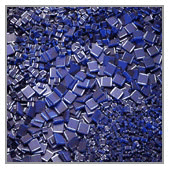
Multi-layer
ceramic capacitors store energy in electronic
devices in the form of an electrostatic field.
Typically, they consists of two coated conducting
plates separated by an insulating material called
the dielectric. They are used in broadcasting
equipment, mobile telephones, computers, electronic
lighting and high voltage circuits to name but
a few applications. Because of their conductivity,
durability, high temperature stability and oxidation
resistance, platinum and palladium are used
to coat multi-layer ceramic capacitors. For
the same reasons, these metals are also used
to coat electrodes, the tiny components in all
electronic products which help establish electrical
contact between non-metallic parts of a circuit
and control the flow of electricity. Rhodium
and iridium are also used for this.
|
|
|
Computer
Hard Discs
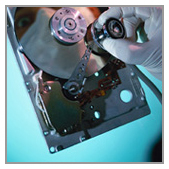
Computers
have impacted on nearly every aspect of our
professional and personal lives in the last
two decades. Magnetic alloys containing platinum
(mainly with cobalt) are now crucial components
in the hard disks of virtually all computers
manufactured today - at least 90% by the start
of 2001. This is the largest single electronic
application for platinum and demand doubled
between 1998 and 2000. Platinum allows for a
greater data storage density and has thus enabled
manufacturers to reduce the number of disks
in each hard drive, falling from an average
of 1.8 to 1.6 in 2000-2001.
|
|
|
Other
sections of this site take you through how platinum
group metals (PGMs) are used in automotive,
technological, industrial, medical and environmental
applications. But elements as versatile and
unique as the PGMs have a myriad of uses that
improve our lives without falling neatly into
those categories.
|



