 Microprocessor
Based Turbidity Meter Model ANALITE 160 Microprocessor
Based Turbidity Meter Model ANALITE 160
|
|
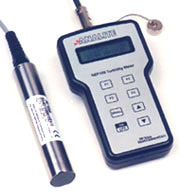
The
ANALITE 160 turbidity meter is the latest of our range
of turbidity measurement instruments. It is designed
to operate with either an ANALITE retro-scatter (180°)
probe or an ANALITE 90° probe - to be specified
at time of order. The ANALITE 160 turbidity meter allows
the user to set up measurement parameters through a
user friendly menu system displayed on the in-built
2 line alphanumeric display. Measurements can be read
directly from the display at any time or downloaded
to a computer/printer through the optional RS232 output
at user selectable periodic intervals. The NEP160 will
power up automatically to its last settings whenever
external power is applied making it ideal for logging
applications when using the analogue output or optional
RS232 port.
|
|
| SPECIFICATIONS |
| Range |
0.0 to
20,000NTU (4,000NTU limit on 90° probe) (over
four ranges automatically determined). |
| Display |
2 line, 16-character dot matrix alphanumeric liquid
crystal display. |
| Display language |
English standard, other languages available to
order. |
| Parameters displayed |
- Turbidity (NTU) - default
- Relative Turbidity Reference (NTU)
- Relative Turbifity (Turbidity - Relative Turbidity Reference
NTU)
- Date/Time - default
|
| Reading |
updated every 1 second. |
| Averaging period |
0.5 second or 10 seconds nominal - user
selectable. |
| Range Steps |
- <0.1 to 20NTU
- <1 to 200NTU
- <10 to 2,000NTU
- <100 to 20,000NTU (using 180° probe only)
|
| Resolution |
- 0.02NTU
- 0.1NTU
- 1NTU
- 10NTU
|
| Repeatability |
2% ± digit on all ranges. |
| Data Logging |
User set for one reading every 1 to 90 seconds or
minutes. All readings stored in the Notepad. |
| Notepad |
100 readings each with time and
date. |
| Setup procedures |
| Menu driven, including: |
- Calibration
- Automatic Logging
- Analogue output range selection
- Reference Turbidity value
- Setting date and time.
| |
| Setup memory |
Non-volatile EEPROM. |
| Clock |
Calendar clock displays date and time. Year 2000
compliant. |
| Good Laboratory Practice |
All readings as well as calibration constants are
stored together with the Time and Date and can be recalled at and
time. |
| Analogue Output |
0 - 2 volts full scale corresponding to preset
measurement range. Output impedance 600 ohms nominal. |
| Power |
- Internal: 6V NiMH rechargeable battery.
- External: 12 to 16V dc, 100mA max. incl. NiMH Charge
current.
|
| Power management |
Automatic power down when operating from batteries
after approx. 5 minutes may be selected. Automatic power up when powered
externally.
Low battery indication prior to shut down. |
| Measurement outputs |
Inbuilt LCD, analogue output and optional RS232
port. |
| RS232 Port (optional) |
The optional RS232 port can output readings on
request or at preset intervals of time from 1 to 90 seconds or minutes. The
Notepad memory can also be downloaded on request. 9600 baud rate, 8 bits, no
parity, 1 stop bit, Xon/Xoff protocol. |
| Dimensions |
187mm x 110 mm x 51 mm (display
unit) |
| Weight |
Display unit: 0.5kg
180° probe: 0.2kg with 2m
lead
90° probe: 0.2kg with 2m lead |
| Operating temperature |
0 to 50°C |
| Operating humidity |
0 to 90% RH |
| Storage temperature |
-10 to 60°C |
| Case rating |
IP65 |
|
Turbidity
Meter (WQ770)
|
|
The
Global Turbidity Sensor is a highly accurate submersible
instrument for in-situ environmental or process monitoring.
Applications include; water quality testing and
management, river monitoring, stream measurement, reservoir
water quality testing, groundwater measuring, water
and wastewater treatment, effluent, and industrial control.
Method:
In
accordance with USEPA Method 180.1 for turbidity measurement
the sensor is a 90 degree scatter nephelometer where
a focused beam is directed into the monitored water.
The light beam reflects off particles in the water,
and the resultant light intensity is measured by a photodetector
positioned at 90 degrees to the light beam. The
detected light intensity is directly proportional to
the turbidity of the water. The turbidity sensor
utilizes a second light detector to correct for light
intensity variations, color changes, and minor lens
fouling.
|
|
|
Turbidity
Meter:
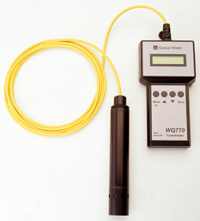
The
Global Water Turbidity Meter combines the turbidity
sensor with a handheld meter that has a six digit LED
screen, 4-button control panel, and an internal 9V battery.
The handheld portable water meter can be used
for enivronmental or process sites that do not require
permanent monitoring. The meter will display readings
directly in either nephelometric turbidity units (NTU)
or parts per million (PPM). It also includes an automatic
shutoff feature to conserve battery power.
Range:
Sensor=0-50 NTU and 0-1000 NTU; Meter=0-50 NTU or 0-1000
NTU
Accuracy:
+ 5% of full scale
Meter
Resolution: 12 bit
Method:
Nephelometer with correction
Operating
Voltage: 10-36 VDC @ 40 MS (Sensor); Internal 9VDC battery
(Meter)
Current
Draw: 31 mA plus sensor output (WQ710)
Warm-up
Time: 10 seconds minimum (Sensor)
Operating
Temperature: -40° to +50°C
Materials:
Black anodized aluminum, stainless steel, delrin, Sapphire
optical windows, Polyurethane jacketed cable.
Pressure:
0-50 psi
Light
Source: pulsed LED
Cable
Length: Sensor=25' standard (optional to 500'); Meter=10'
standard (optional to 100')
Size:
Body= 1 1/2"D x 8.5"L Sensor Shield=
1 1/2" x 2" Overall Length: 9"
Weight:
2 lbs.
|
Series
A15/76 Turbidity Monitor
|
|
Turbidity
is a general indicator of the optical clarity of water
and is defined as the amount of light scattered from
particles in solution. In practice, a light beam is
directed into a water sample and a photo detector measures
the light scattered at 90° to the incident light
beam. While other scatter angles are possible, the 90°
measurement angle has become the standard for turbidity
measurement in most water systems. It is used as a relative
indicator of the amount of suspended solids in solution
and is measured in virtually all drinking water systems.
It is also used in industrial water treatment systems
as an indicator of product water quality.
|
|
|
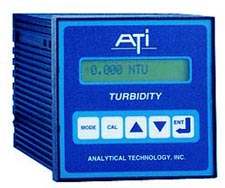
Model
A15/79 Turbidity Monitor is designed to meet the needs
of both municipal drinking water systems and industrial
water treatment for reliable, low range turbidity measurement.
Using an infrared light source and a 90° scatter
measurement, the system provides high sensitivity measurement
with unmatched zero stability. Turbidity measurements
down to 0.001 NTU or as high as 4000 NTU can be measured
with the same monitor, eliminating the need for separate
high and low range instruments.
|
|
|
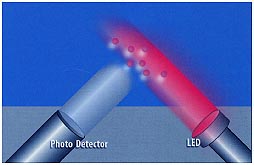
The
turbidity sensor used in the A15/76 is a planer sensor
with the light source and photo detector mounted on
a flat face. Lenses in front of the light source direct
the beam of light at a 45° angle into the sample.
Another lens in front of the photodetector collects
the 90° scattered light and directs it to the detector.
The signal generated by the detector is amplified inside
the sensor for transmission to the display unit. Periodic
pulsing of the light source allows the sensor zero to
be adjusted automatically for improved stability in
low range applications.
Turbidity
sensors are available for measurement in a pressurized
flowcell or for direct submersion in open tanks. The
flowcell is required for very low measurements (0-4
NTU), while the submersion unit may be used for higher
turbidity applications such as wastewater effluent or
raw water.
Air
bubbles are a common problem in many turbidity systems.
ATI's turbidity sensor is designed to operate under
pressure to eliminate the sample degassing that often
causes air bubble errors. Sample pressure in not dropped
until the sample exits the measuring chamber, resulting
in more reliable measurements. The turbidity electronics
unit is a compact panel mount instrument providing an
LCD display of turbidity value, as well as indication
of alarm status and instrument diagnostics. For stand
alone applications, a NEMA 4X wall mount enclosure is
available.
The
monitor provides display of turbidity over a variety
of operating ranges. The minimum display range of 0-4
NTU provides resolution down to 0.001 NTU and is suitable
for almost any final filter monitoring application.
Range of 0-40 or 0-400 NTU are available for raw water
or clarifier effluent monitoring. A0-4000 NTU range
may be used for very high turbidity applications such
as river water monitoring. In addition, the monitor
may be calibrated fur suspended solids measurements,
with range from 0-10 mg/l up to 0-10,000 ml/l.
Standard
turbidity systems provide a variety of outputs. Two
programmable alarms with SPDT alarm relays are included,
as well as an isolated 4-20 mA output. The analog output
may be programmed for full scale outputs as low as 0-0.2
NTU and can inverted if desired. Alarm and output information
can be displayed on the LCD at the push of a button
and the alarm relays can be activated manually for test
purposes when needed.
A15/76
monitors also provide sensor diagnostic functions to
warn of conditions that cause inaccurate or invalid
readings. The sensor is continuously monitored for optical
fouling and will display an alarm message when the sensor
requires cleaning. In addition, the sensor will detect
the lack of water in the flowcell and provide a "dry
cell" when an air interface is detected. These
alarm conditions will cause a third alarm relay to activate,
which can be used to indicate these conditions remotely.
Because
turbidity measurement is often required in wastewater
effluents and other applications where sensor fouling
can be a major problem, ATI offers a special turbidity
unit, the B15/76 system, that uses an "air blast"
sensor cleaning system that automatically cleans the
sensor as often as necessary to maintain reliable measurements.
This system is used only for submersion applications
only, and all air supply components required for the
cleaning process are supplied in the NEMA 4X monitor
package.
| Range |
4/400 NTU (0-4.000, 0-40.00, 0-400.0) |
| 40/4000 NTU (0-40.00, 0-400.0, 0-4000) |
| 9/999 mg/l (or ppm) SiO2 (0-9.999, 0-99.99,
0-999.9) |
| 99/9999 mg/l (or ppm) SiO2 (0-99.99, 0-999.9,
0-9999) |
| Auto ranging over 3 decades of
concentration |
| Accuracy |
+/- 5% of reading or +/- 0.02 NTU, whichever is greater, on 40/400
scale +/- 10% of reading or +/- 2 NTU whichever is greater |
| Linearity |
0.1% of FS |
| Display |
16 character alphanumeric backlit LCD |
| Control Relays |
Two SPDT relay, 5A @ 220 VAC resistive,
programmable deadband and time delay |
| Control Mode |
On/off |
| Alarm Relay |
Independent SPDT relay, 5A @ 220 VAC resistive,
programmable for actuation on high/low values or control failure, also indicates
dry cell condition, fouled sensor or high ambient light |
| Analog Output |
Isolated 4-20 mA, 600 ohm maximum load, programmable output span,
output range user set |
| Temperature |
-20-55°C |
| Humidity |
0-95% RH, non-condensing |
| Power |
110/220 VAC +/- 10%, 50/60 Hz |
| Enclosure |
Panel mount standard, NEMA 4X wall mount optional |
| Sensor Range |
0-4000 NTU |
| Measurement Angle |
90 degree scatter (nephelometric) |
| Response Time |
95% in 10 seconds |
| Sensor Power |
+/- 12 VDC supplied by monitor, preamplifier in sensor
head |
| Sensor Temperature Limit |
0-50°C |
| Sensor Pressure Limit |
0-100 psig |
| Connections |
7 conductor sensor cable, 30 feet standard, 350
feet maximum |
| Sensor Materials |
Delrin body, acrylic optical windows |
| Flowcell Materials |
PVC |
| Flowcell Connections |
4 mm tube fittings (black tubing supplied) |
| Flowcell Pressure |
0-100 psig |
| Flowcell Temperature |
0-60°C |
|
 go to product
order go to product
order
For any particular request please
contact:
info@flokal.eu
|


